
Carolyn-Day Early Childhood Education Centers
Specialized early childhood education and therapeutic services for children ages 3–5 with developmental delays and disabilities — at two centers on South 60th Street, Philadelphia.
Is this program right for my child? →
Ages 3–5
Two Philadelphia centers
Who the program is for
Children enrolling at Carolyn-Day are referred through the Elwyn Early Intervention 3–5 Pre-School Program and have completed the evaluation process, so that an Individualized Education Program (IEP) is in place before they start. If your child is still in evaluation, contact us anyway — we can talk you through the next step.
Ages 3 to 5
Developmental delays & disabilities
An IEP in place
Who the program is for
Our two Carolyn-Day centers sit next door to one another in West Philadelphia, both running morning and afternoon sessions Monday through Friday.
Carolyn-Day ECE Center One
274 S. 60th Street
Philadelphia, PA 19139
Carolyn-Day ECE Center Two
276 S. 60th Street
Philadelphia, PA 19139
Our approach
Our goal is an environment where children learn, communicate, build relationships, develop independence, and prepare for their next educational setting.

Classroom teaching designed around each child’s developmental needs, delivered by special education teachers.

Many of the services identified in a child’s IEP are incorporated into the school day rather than added on top of it.

Educators, therapists, paraeducators and behavioral staff work together so goals are reinforced all day long.
Services & supports
Depending on each child’s IEP and individual needs, ALFS provides and coordinates the following services.
Teaching adapted to how your child learns, delivered by a special education teacher and built around the goals in your child’s IEP.
Support for understanding language and for communicating — whether that is through speech, gestures, pictures or a communication device.
Help with the everyday skills a young child needs: using their hands, managing sensory input, and building independence in things like dressing, eating and play.
Support for movement, strength, balance and coordination, so your child can take part fully in classroom and playground activities.
A licensed clinician who assesses what is driving a child’s behavior and writes the behavior plan that the classroom team then follows.
One-to-one support during the school day for children who need help with personal care, safety, or staying engaged in classroom activities.
The day-to-day delivery of that behavior plan inside the classroom, using applied behavior analysis methods.
Support shaped around each child’s specific goals rather than a fixed program every child moves through.
Preparing your child for their next classroom: following routines, playing alongside other children, managing feelings, and asking for help.
What makes Carolyn-Day different
At most programs, therapy happens somewhere else — a different building, a different day, a different person. At Carolyn-Day, the people who teach your child and the people who support your child work side by side, in the same classroom, toward the same goals.
Classroom instruction built around each child’s IEP, not around a fixed curriculum.
Hands-on support through routines, transitions, play and peer interaction.
Everything points to
Your child’s
Therapy delivered inside the school day, so skills are practised where they are actually used.
Positive behavior supports reinforced consistently by every adult in the room.
A day at Carolyn-Day
The centers operate Monday through Friday with morning and afternoon programming.
8:30 – 11:30 AM
Monday to Friday, in small early-learning classrooms with a special education teacher, paraeducators and access to therapeutic staff.
12:30 – 3:30 PM
The same classroom model and the same team, running Monday to Friday in the afternoon.
Across every session, programming focuses on
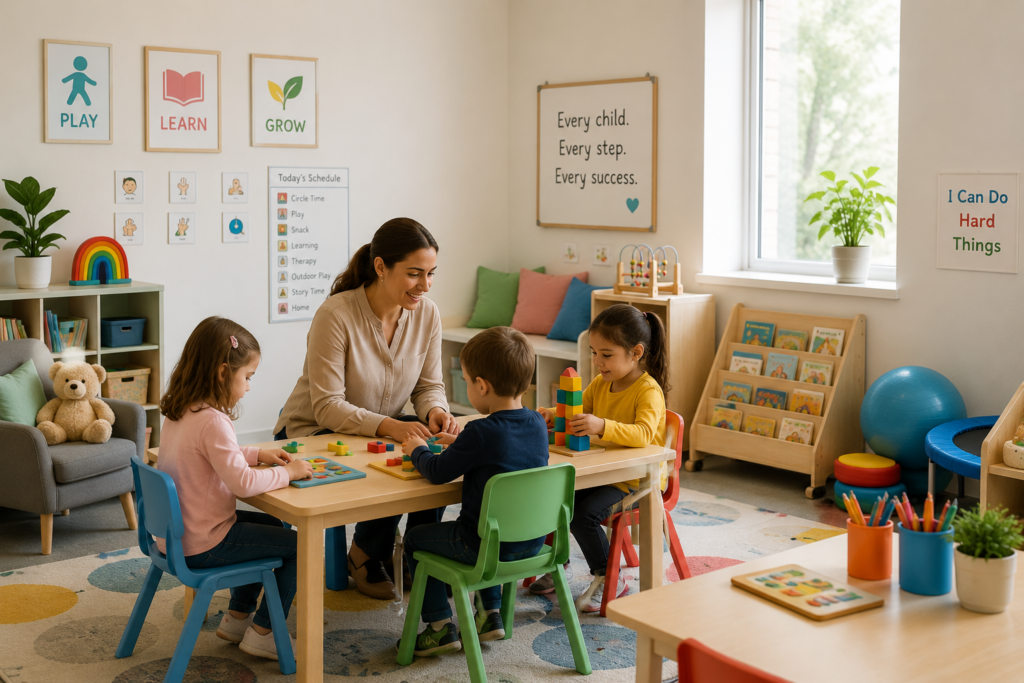
Inside the classroom
The classrooms are designed as small, supportive early-learning environments with special education teachers, paraeducators, and access to dedicated clinical and therapeutic professionals.
Programming is play-based and developmentally appropriate. Children learn through activities that look like play to them and are built around IEP goals for the adults guiding them — which is exactly how learning should feel at this age.
Because the same team is present all day, a skill practised in therapy is reinforced minutes later at the snack table, in the book corner, or on the playground.
Our partnership
Children come to the Carolyn-Day Centers through the Early Intervention system. After the appropriate evaluation and intake process, a child’s educational and therapeutic needs are identified in their Individualized Education Program.
ALFS then works in coordination with Elwyn Early Learning Services to provide the specialized educational, therapeutic and behavioral services authorized for that child. What each child receives is driven by their IEP — there is no single program every child is placed into.
The result is one coordinated early childhood program, in one place, where education, therapy, behavioral support and school readiness work together rather than separately.
1
Referral through Early Intervention
2
Evaluation and intake
3
The IEP is written
4
Services begin at Carolyn-Day
Parent questions
Yes. Children enrolling at Carolyn-Day are referred through the Elwyn Early Intervention 3–5 Pre-School Program and have completed the evaluation process, so an IEP is in place before they start. If your child is still in evaluation, contact us anyway — we can talk you through the next step.
Transportation to and from the Carolyn-Day Centers is arranged and provided through Elwyn Early Intervention. If you are unsure what applies to your child, contact us and we will help you find out.
Carolyn-Day is designed to prepare your child for their next educational setting. As your child approaches kindergarten age, our team works with you and with Elwyn on the transition, so that the supports identified in your child’s IEP follow them into their new classroom.
Your child’s progress is monitored throughout the school day and measured against the individualized goals in their IEP. Families receive formal progress reports quarterly.
At least once each year, the IEP team – including you, Elwyn’s LEA representative, your child’s classroom team, and relevant specialists such as speech, occupational therapy, physical therapy and behavioral services – meets to review progress and update the IEP as needed.
Behavior is communication. When a child is struggling, our first step is to understand what the behavior is telling us — what happened before it, what the child was trying to achieve, and what would help.
A Licensed Behavior Specialist assesses this and writes a positive behavior support plan, which every adult in the classroom then follows consistently. Families are part of that plan, not informed of it afterwards.
Get in touch
Tell us a little about your child and someone from our intake team will get back to you. If you are partway through the Early Intervention process and not sure where you stand, that is exactly the kind of call we are happy to take.